
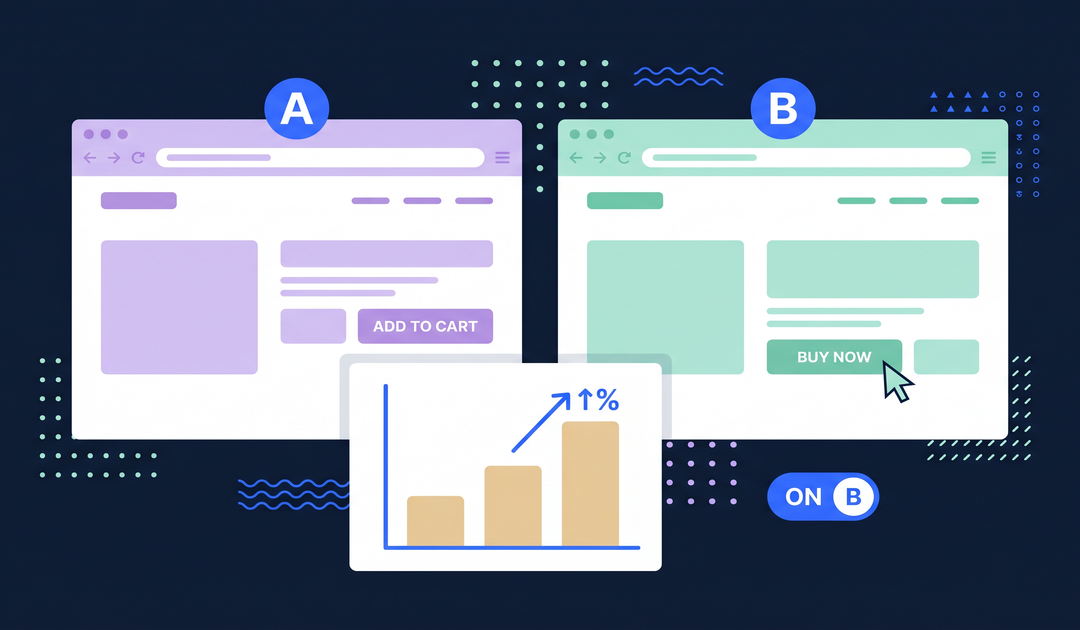
Shopify A/B Testing: The 2026 Data Driven Guide to Higher Conversions
Key Takeaway: Shopify A/B testing is the systematic process of comparing two versions of a store page to determine which one generates more revenue. Recent data shows that 36.3% of ecommerce A/B tests produce a statistically significant winner, with successful tests delivering a median 2.77% uplift in revenue per visitor. Focusing on high impact areas like product pages and cart flows yields the highest return on investment.
Table of Contents
- The Mathematics of Shopify A/B Testing
- Where to Test First: Win Rates by Page Type
- High ROI Test Concepts for Ecommerce
- The A/B Testing Process for Scaling Brands
- Common Testing Mistakes to Avoid
- Frequently Asked Questions
- Conclusion
The Mathematics of Shopify A/B Testing
Shopify A/B testing requires statistical rigor to produce meaningful business outcomes. You cannot rely on intuition or gut feeling when optimizing a store doing seven figures in revenue. Every change must be validated through controlled experiments that measure actual customer behavior against a baseline.
Recent analysis of over 2,700 ecommerce experiments reveals a power law distribution in testing outcomes. A comprehensive Wharton meta analysis found that just 20% of experiments drive 81% of aggregate conversion uplift. This data underscores the critical importance of testing velocity and getting many shots on goal.
The baseline success rate for ecommerce testing is lower than most founders expect. Across thousands of tests on European ecommerce brands, only 36.3% produced a statistically significant win. However, when excluding inconclusive tests, 62.1% of decisive outcomes were positive. This means when a change has a measurable effect, it is roughly 1.6 times more likely to help your conversion rate than to hurt it.
The financial impact of these winning tests is substantial. Successful experiments deliver a median 2.77% uplift in revenue per visitor. The top quartile of winning tests achieves 5.21% or higher revenue improvement. Compounding these incremental wins over time is how eight figure brands are built.
Where to Test First: Win Rates by Page Type
Product Detail Pages offer the highest probability of a winning A/B test. These pages account for 47% of all ecommerce experiments and boast a 37.6% win rate. The product page is where the actual buying decision occurs, making it highly sensitive to optimization.
Cart pages represent the second best testing opportunity. They deliver a 37.0% win rate while maintaining the lowest loss rate at just 19.5%. Testing at this stage of the funnel is highly effective because you are optimizing for users who have already demonstrated high purchase intent.
| Page Type | Win Rate | Loss Rate | Decisive Win Rate | Share of Tests |
|---|---|---|---|---|
| Product Detail Page | 37.6% | 20.3% | 65.0% | 47.0% |
| Cart Page | 37.0% | 19.5% | 65.5% | 9.1% |
The effectiveness of specific offers changes depending on where they appear in the funnel. List price promotions tend to lose effectiveness as shoppers move deeper into the buying journey. Conversely, shipping incentives become significantly more powerful when surfaced on cart or checkout pages. What you offer and where you surface it jointly drive purchase behavior.
For more insights on optimizing the bottom of your funnel, review our comprehensive guide on Shopify checkout optimization.
High ROI Test Concepts for Ecommerce
Scarcity and FOMO elements consistently rank among the highest performing A/B tests. These psychological triggers achieve an 84.2% decisive win rate when tested properly. Implementing low stock warnings or limited time offer countdowns creates urgency that forces a purchasing decision.
Shipping and return communication is another high volume testing category with strong returns. Clarifying delivery timelines, return policies, and free shipping thresholds directly addresses the most common objections buyers have before checkout. Clear communication reduces friction and increases trust.
Popup design and timing optimization yields surprisingly high win rates. Tests involving email capture popups show a 72.0% overall win rate. Refining the trigger timing, exit intent logic, and the specific incentive offered can dramatically increase your owned audience growth rate.
Product reservation messaging is highly effective for limited inventory brands. Informing a user that an item is reserved in their cart for a specific duration creates both urgency and perceived value. This test concept boasts a 62.5% win rate across ecommerce stores.
The A/B Testing Process for Scaling Brands
Successful Shopify A/B testing requires a systematic framework rather than random experimentation. The process begins with qualitative and quantitative research to identify friction points in the user journey. You must analyze session recordings, heatmaps, and Google Analytics data to find where users are dropping off.
Every test must start with a structured hypothesis. A strong hypothesis defines the specific change being made, the expected behavioral outcome, and the business metric it will impact. “Changing the button color to red will increase add to cart rates by 2% because it creates higher visual contrast” is a testable hypothesis.
You must calculate the required sample size before launching any experiment. Running tests without sufficient traffic leads to false positives and statistical noise. The duration of the test depends entirely on your baseline conversion rate, the minimum detectable effect you want to measure, and your daily traffic volume. The median test duration for ecommerce brands is 42 days.
Analyzing the results requires looking beyond the primary metric. A test might decrease the overall conversion rate but increase the average order value enough to generate higher total revenue. You must evaluate the impact on revenue per visitor to determine the true business value of the experiment.
For a deeper dive into establishing your baseline metrics, read our ecommerce conversion rate optimization guide.
Common Testing Mistakes to Avoid
Calling tests too early is the most frequent mistake made by Shopify merchants. Statistical significance alone is not enough to declare a winner. You must let the test run for full weekly cycles to account for behavioral differences between weekdays and weekends. Stopping a test after three days because it reached 95% significance will almost always result in a false positive.
Testing too many variables at once ruins the integrity of the experiment. If you change the headline, the hero image, and the button copy simultaneously, you will never know which element caused the change in conversion rate. Multivariate testing requires massive traffic volumes that most Shopify stores do not possess.
Benchmarking against global averages instead of your own historical data leads to poor decision making. The average global ecommerce conversion rate hovers around 2% to 3%, but this varies wildly by industry. Food and beverage stores average 6.22%, while luxury goods average 0.94%. You must benchmark against your own store’s performance.
Ignoring secondary metrics can cause you to implement losing variations. A new product page layout might increase add to cart rates by 15%, which looks like a massive win. However, if those users abandon their carts at a higher rate because the new layout obscured important shipping information, your overall revenue will decrease.
Frequently Asked Questions
What is a good A/B testing win rate?
A good A/B testing win rate for ecommerce is between 30% and 40%. Recent data across 90+ European brands shows an average win rate of 36.3%. A win rate significantly higher than this usually indicates you are only testing obvious fixes rather than pushing boundaries.
How long should a Shopify A/B test run?
A Shopify A/B test should run for a minimum of two full weeks to account for day of week variations in shopping behavior. The exact duration depends on your traffic volume and the minimum detectable effect. The median test duration for significant ecommerce experiments is 42 days.
Which page should I A/B test first?
You should test your Product Detail Pages first. PDPs account for 47% of all ecommerce experiments and have the highest win rate at 37.6%. This is where the actual buying decision occurs, making it the highest leverage point in your funnel.
What percentage of A/B tests fail?
Approximately 63.7% of ecommerce A/B tests fail to produce a statistically significant positive result. This includes tests that actively decrease conversions and tests that are inconclusive. This high failure rate highlights the need for a high testing velocity.
How much revenue can A/B testing generate?
Winning A/B tests generate a median 2.77% uplift in revenue per visitor. The top 25% of successful tests achieve a 5.21% or higher improvement in revenue. Compounding these incremental gains over multiple tests leads to massive revenue growth.
Conclusion
Shopify A/B testing is the engine that drives predictable ecommerce growth. By focusing your testing efforts on high leverage areas like product pages and relying on statistical rigor rather than intuition, you can systematically improve your revenue per visitor.
If you are running a Shopify brand doing $1M+ per month and want to unlock incremental revenue through systematic optimization, see how Scaling.co can help.
Найдите контент для взрослых, исследуя надежные платформы в Интернете.
Изучите надежные порнохабы для приватного просмотра.
my web page :: СКАЧАТЬ ЛУЧШИЕ ПОРНО ВИДЕО
Just want to say your article is aas astonishing. The
clearness inn your post is simply cool annd i could assume you are an expert on this subject.
Fine with your permission let me to gfab yoyr feed tto keep uup to date with forthcoming
post. Thanks a millijon and please carry on the rewading work.
Here is my web site; buy viagra online
Взрослый доступен через гарантированные
веб-сайты. Изучите безопасные сайты для взрослых для получения качественного контента.
Also visit my blog; Купить Ривотрил
https://shorturl.fm/PvMpB
[594725]supplies professional anti-violence equipments and solutions for the whole world with strong and perfect production capacity. anti-violence.org