
How to Reduce Cart Abandonment on Shopify: 2026 Data Guide
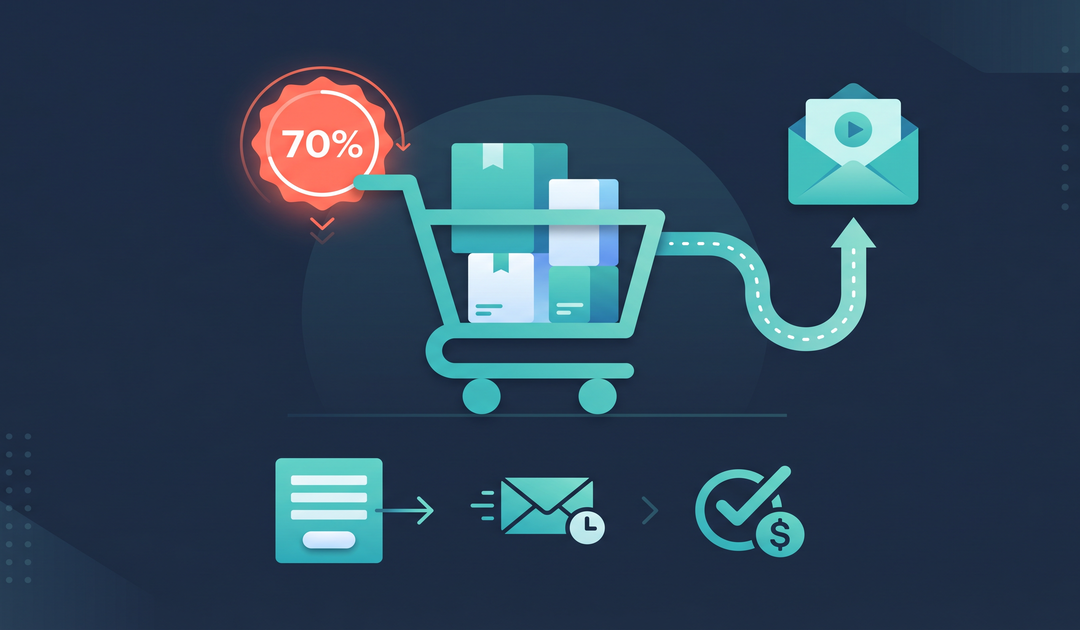
Key Takeaway: To reduce cart abandonment on Shopify, brands must eliminate unexpected fees, optimize the checkout flow, and deploy a rapid email recovery sequence. The average cart abandonment rate is 70.22%, but top-performing stores recover up to 15% of lost sales by sending the first recovery email within 60 minutes.
Table of Contents
- The True Cost of Cart Abandonment
- Why Shoppers Abandon Carts on Shopify
- Optimize the Checkout Experience
- Deploy an Aggressive Email Recovery Sequence
- Leverage Exit-Intent Technology
- Build a Cart Abandonment Prevention Checklist
- Frequently Asked Questions
- Conclusion
The True Cost of Cart Abandonment
Cart abandonment represents the single largest revenue leak for ecommerce brands today. According to the Baymard Institute’s analysis of 50 independent studies, the average documented online shopping cart abandonment rate is 70.22%. This means that for every ten customers who add an item to their cart, seven leave without completing the purchase.
For a Shopify store generating $1M in monthly revenue, a 70% abandonment rate translates to millions of dollars in unrealized sales annually. However, this is not a lost cause. Baymard’s research indicates that the average large ecommerce site can gain a 35.26% increase in conversion rate purely through better checkout design. Recovering even a fraction of these abandoned carts is the most cost-effective way to scale your revenue without increasing your customer acquisition costs.
Why Shoppers Abandon Carts on Shopify
Understanding why users abandon their carts is the first step to fixing the problem. While a significant portion of shoppers (43%) are simply browsing or not ready to buy, the remaining abandonments are driven by friction points that you can control.
When isolating the users who had high purchase intent but failed to convert, the data reveals clear operational and UX failures. The primary culprits are financial surprises and complex processes.
| Reason for Abandonment | % of Users | Impact |
|---|---|---|
| Extra costs too high (shipping, tax, fees) | 39% | Critical |
| Delivery was too slow | 21% | High |
| Site wanted me to create an account | 19% | High |
| Didn’t trust site with credit card info | 19% | High |
| Too long / complicated checkout | 18% | High |
The most glaring issue is unexpected costs. If a customer reaches the final step of your Shopify checkout only to discover a $15 shipping fee they were not anticipating, they will leave. Transparency is your strongest weapon against abandonment. For a broader look at increasing your store’s performance, review our guide on how to increase ecommerce sales.
Optimize the Checkout Experience
A frictionless checkout is the foundation of cart abandonment prevention. The average US checkout flow contains 23.48 form elements, yet usability testing shows an ideal checkout requires only 12 to 14 elements. Every unnecessary field is an invitation for the user to exit.
To streamline your Shopify checkout, absolutely ensure that guest checkout is enabled. Forcing users to create an account before purchasing is responsible for 19% of abandonments. Utilize Shopify’s native express checkout options like Shop Pay, Apple Pay, and Google Pay, which allow users to bypass manual data entry entirely.
Furthermore, address the trust factor. Display recognizable security badges, SSL certificates, and clear return policies directly on the checkout page. When users feel secure and the process is swift, they are far less likely to second-guess their purchase. You can dive deeper into these strategies in our comprehensive Shopify checkout optimization guide.
Deploy an Aggressive Email Recovery Sequence
When preventative measures fail, recovery tactics must take over. An automated abandoned cart email sequence is non-negotiable for high-revenue brands. The speed of your first email is the most critical variable in the entire recovery process.
Industry benchmarks show that the first abandoned cart email should be sent within 60 minutes of abandonment. Emails sent within this window routinely achieve open rates between 41% and 50%. The standard best practice is a three-email sequence: the first at one hour (helpful reminder), the second at 24 hours (urgency or social proof), and the third at 72 hours (a final incentive or discount).
Do not rely solely on generic templates. According to data from Contentsquare, the average conversion rate for shopping cart abandonment emails is 10.7%. However, AI-optimized and highly personalized emails can significantly outperform this baseline. Include the specific product image, a direct link back to the populated cart, and dynamic recommendations based on their browsing history.
Leverage Exit-Intent Technology
Exit-intent popups offer a final opportunity to capture a sale before the user leaves your site entirely. These overlays detect when a user’s cursor moves toward the browser’s close button or back button, triggering a targeted message.
While average exit-intent popups convert at around 2% to 5%, top-performing implementations can reach conversion rates exceeding 19%. The difference lies in relevance. Do not show a generic “Join our newsletter” popup to a user abandoning a full cart. Instead, trigger a specific cart abandonment popup offering to save their cart, providing a small immediate discount, or highlighting your free shipping threshold.
For Shopify stores, several apps enable sophisticated exit-intent targeting. The most effective approach segments the popup message based on cart value. A shopper with $200 in their cart deserves a different offer than someone with a $30 item. Consider offering free shipping for carts above a certain threshold, or a time-limited percentage discount for high-value carts. This targeted approach maximizes recovery without eroding your margins across the board.
Build a Cart Abandonment Prevention Checklist
Prevention is always more efficient than recovery. Before investing heavily in recovery emails and popups, audit your Shopify store against the most common abandonment triggers.
Start by reviewing your shipping and pricing transparency. Ensure that estimated shipping costs are visible on the product page or in the cart, not just at the final checkout step. Display your return policy prominently and make delivery timelines crystal clear. These simple transparency measures directly address the top three reasons users abandon their carts.
Next, evaluate your checkout flow length. Count every form field, dropdown, and required interaction between the cart and the confirmation page. If you are asking for information that is not strictly necessary to fulfill the order, remove it. Every additional field increases the probability that a user will abandon the process. For brands looking to optimize their overall store performance, our Shopify conversion rate optimization guide covers the full spectrum of improvement opportunities.
Frequently Asked Questions
What is a good cart abandonment recovery rate?
A good cart abandonment recovery rate typically falls between 5% and 10%. However, top-tier ecommerce brands with highly optimized email and SMS recovery sequences can achieve recovery rates above 12%. The success of your recovery efforts depends heavily on the speed and personalization of your first outreach.
How do you reduce cart abandonment on Shopify?
To reduce cart abandonment on Shopify, you must eliminate unexpected shipping costs, enable guest checkout, offer accelerated payment options like Shop Pay, and deploy a rapid three-part email recovery sequence starting within 60 minutes of abandonment.
Why is my Shopify cart abandonment rate so high?
High cart abandonment rates on Shopify are usually caused by hidden fees revealed only at checkout, slow delivery times, forced account creation, or a complicated checkout process. If your rate is significantly above the 70% average, you likely have a critical friction point in your checkout UX.
Does free shipping reduce cart abandonment?
Yes, offering free shipping is one of the most effective ways to reduce cart abandonment. Since 39% of users abandon carts due to high extra costs, being transparent about shipping or absorbing the cost into the product price eliminates the primary reason shoppers leave without buying.
Conclusion
Reducing cart abandonment on Shopify requires a dual approach: aggressively removing friction from the checkout process and implementing rapid, personalized recovery sequences when users do leave. By addressing unexpected costs, streamlining the user experience, and deploying timely recovery emails, you can reclaim a significant portion of the 70% of carts that are typically abandoned. The brands that treat cart abandonment as a systematic optimization problem rather than an inevitable loss are the ones that consistently outperform their competitors.
If you are running a Shopify brand doing $1M+/month and want to unlock incremental revenue through systematic optimization, see how Scaling.co can help.
Trackbacks/Pingbacks